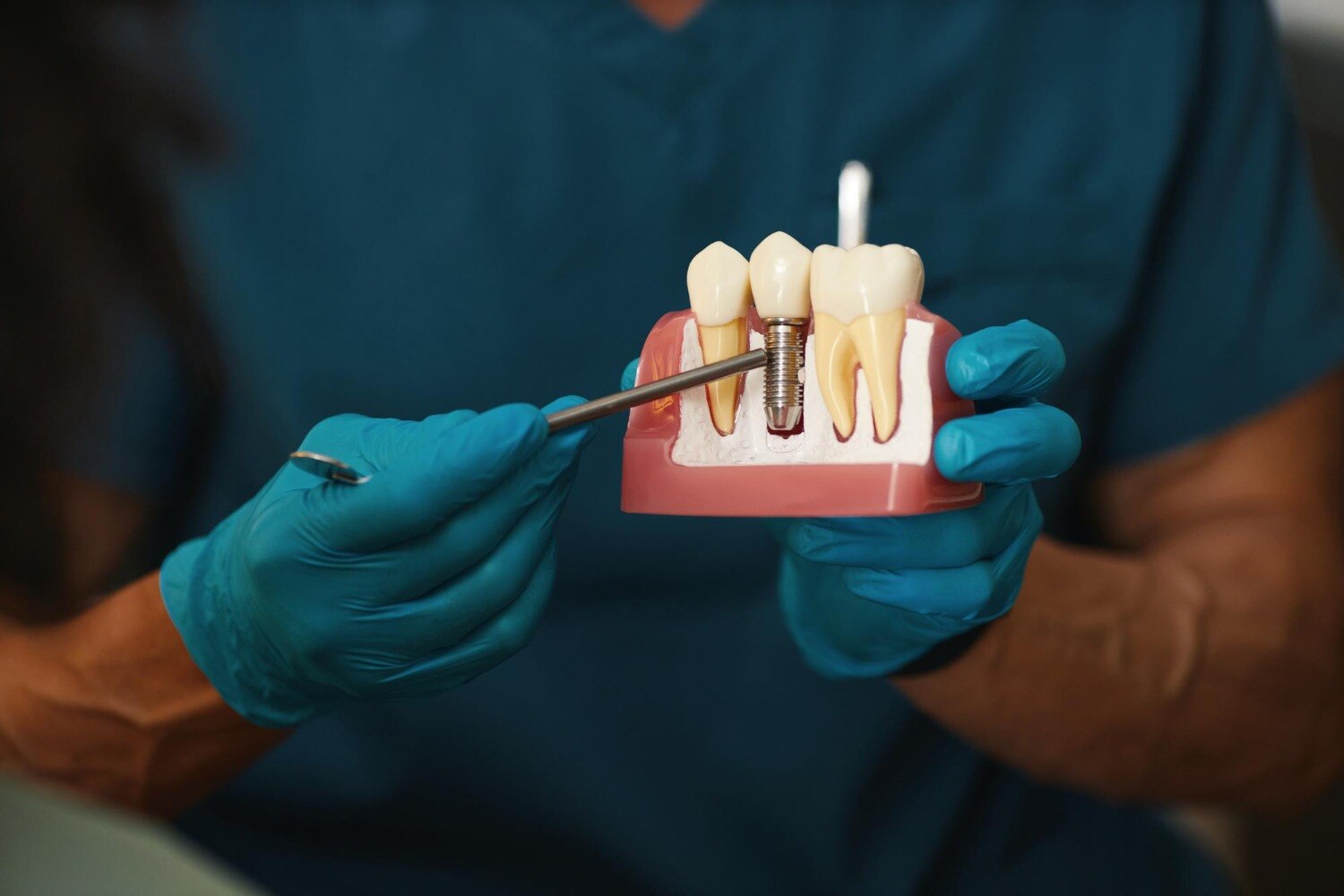
A missing tooth leaves more than a visible gap: it changes how forces move through the bite and can make chewing less efficient. By understanding the implant parts, treatment stages, eligibility checks, and maintenance demands, you can judge which implant-supported solution fits your mouth and what questions to ask before treatment.
Key takeaways
- An implant replaces the tooth root; a crown replaces the visible tooth.
- A scan, gum assessment, and medical history guide safe implant planning.
- Implant bridges and overdentures replace several teeth with fewer fixtures.
- Brush, clean between teeth, and attend reviews to protect the implant long term.
What an implant replaces—and what sits above it
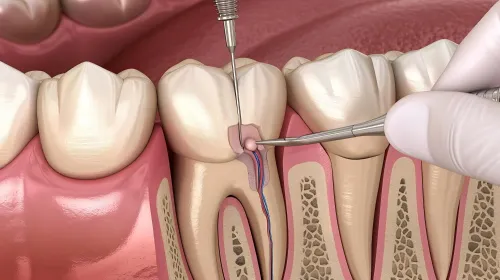
A functioning implant tooth is an assembly, not a single replacement part. It replaces the missing tooth root inside the jaw and supports a visible restoration above the gum. For one missing tooth, the parts are:
- Dental implant fixture: a screw-shaped titanium implant placed in the jawbone.
- Abutment: the connector that extends through or above the gum.
- Implant crown: the visible tooth-shaped restoration fixed to the abutment.
After placement, bone grows closely around the fixture in a process called osseointegration. This bond gives the restoration a stable foundation for biting and chewing; placing normal chewing forces on an unhealed fixture can prevent proper integration or cause movement.
The implant crown restores the tooth’s visible shape and chewing surface, while the fixture replaces the root. It does not recreate the periodontal ligament that surrounds a natural root, so an implant-supported tooth has different pressure feedback and does not move in the same way.
The fixture cannot develop dental caries, but the surrounding tissues can develop peri-implant mucositis or peri-implantitis. The crown, abutment, or connecting screw can also loosen, fracture, chip, or lose retention. A single fixture can support one crown, while multiple fixtures can support a bridge or denture.
How implant treatment progresses from examination to a final tooth
Treatment usually takes several stages because the implant must become stable in bone before it supports a finished tooth.
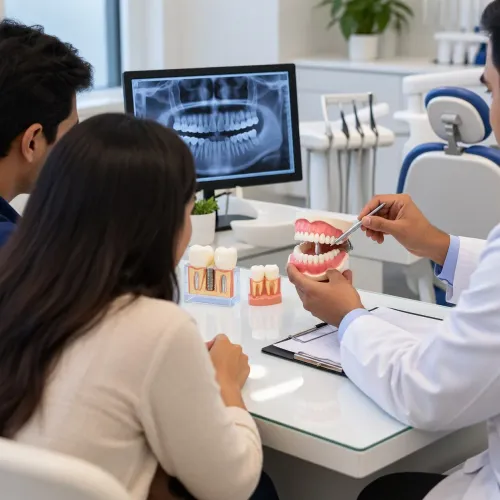
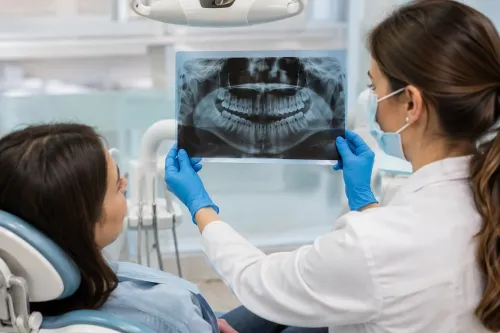
1. An implant examination reviews your medical history, gum health, remaining teeth, bite and cleaning habits. Dental X-rays show roots and jaw structures; 3D CBCT imaging maps bone height, width, nerves and sinus position when two-dimensional images are insufficient.
2. If a tooth remains, the plan may include tooth extraction and implant placement in one appointment. Immediate placement requires intact socket walls, manageable infection, suitable soft tissue and enough bone for initial stability; otherwise, the socket heals first.
3. The clinician places the titanium implant fixture inside the jawbone. If the ridge is too narrow or short, bone grafting or another site-development procedure adds a separate healing stage before placement.
4. During healing, bone grows into close contact with the implant surface. This osseointegration creates a firm foundation; loading an unstable fixture with normal chewing forces can cause movement, prevent bone bonding and jeopardise the result.
Healing often takes several months, while immediate or early loading suits only selected cases with strong primary stability and controlled forces.
5. Once integration is confirmed, an abutment is connected through or above the gum. The gum may need time to settle around it.
6. A dentist fits and adjusts the final crown, bridge or denture. The restoration is checked for contact, appearance, speech and bite before you use it normally.
The completed tooth is therefore a fixture, abutment and visible restoration working as one system—not a crown simply glued onto the gum.
Which findings determine whether an implant can be placed safely
A missing tooth is not enough to make implant placement safe. The examination must show sufficient bone volume for primary stability, healthy gum tissues, manageable bite forces, and a medical situation that supports healing and osseointegration.
| Finding | What is checked | Effect on treatment |
|---|---|---|
| Bone volume | Ridge height and width, nerve position, and sinus location on X-rays or CBCT | Limited bone may require bone grafting or sinus augmentation, adding healing stages |
| Gum health | Plaque control, bleeding, pockets, and existing periodontal disease during a periodontal assessment | Active inflammation must be controlled before placement |
| Medical factors | Diabetes control, smoking, immune problems, osteoporosis medicines, and healing history | Poor healing risk can delay, modify, or rule out treatment |
| Bite forces | Clenching, grinding, opposing teeth, and available space | Heavy forces may require bite protection, altered loading, or a stronger restoration |
| Follow-up capacity | Daily cleaning, review visits, hygiene appointments, and willingness to report symptoms | Missed maintenance increases the risk of inflammation and implant complications |
A narrow ridge does not automatically end candidacy, but it makes treatment more complex. Smoking, uncontrolled diabetes, untreated gum disease, or medicines such as some antiresorptive drugs require careful risk planning rather than a routine promise of success.
Your restoration also depends on control after placement. PRYSM DENTAL STUDIO can use the initial assessment to distinguish a straightforward implant from a case needing site development, staged healing, bite management, or a different tooth-replacement option. If you cannot maintain cleaning and follow-up, postponing treatment may be safer than placing an implant you cannot protect.
Related service
Best Dental Implants Specialist in Deccan Gymkhana, Pune | Prysm Dental Studio by Dr. View service → |
How one implant, an implant bridge, an overdenture, and a full arch differ
A single-tooth implant fits one missing tooth when the neighbouring teeth are healthy and the site has enough bone for stable placement. It supports one crown without routinely cutting down adjacent teeth for a conventional bridge. It is not automatically suitable: bone width, gum health, bite forces, and implant position still determine feasibility.
| Option | What it means | When it applies |
|---|---|---|
| Single-tooth implant | One implant supports one crown | One missing tooth; nearby teeth are sound and local bone is adequate |
| Implant-supported bridge | Two or more implants support several connected crowns | Several adjacent teeth are missing; implants can be positioned where bone and cleaning access permit |
| Implant overdenture | Implants anchor a removable denture through attachments | Many or all teeth are missing, and you need more retention than a conventional denture provides |
| Full-arch fixed restoration | Multiple implants support a non-removable row of teeth | Most or all teeth need replacement and bone distribution, implant stability, and bite control support a fixed design |
An implant-supported bridge does not require one implant for every missing tooth, but the remaining teeth cannot simply compensate for poor implant support. An implant overdenture is removable for cleaning, while a full-arch fixed restoration stays in place and demands stronger implant distribution and meticulous hygiene.
Limited bone can require grafting, a different implant position, or a removable design; the final choice also depends on follow-up care and cleaning ability.
What implants still require after placement
Implants are not maintenance-free because plaque can inflame the surrounding tissues, while chewing forces can damage the restoration or loosen its components. The titanium fixture cannot develop dental caries, but the gum and bone around it remain vulnerable.
| Problem | What it means | Why prompt review matters |
|---|---|---|
| Peri-implant mucositis | Inflamed soft tissue, often with bleeding, but no progressive bone loss | Plaque removal can usually control it before deeper damage develops |
| Peri-implantitis | Inflammation with progressive loss of supporting bone | Treatment becomes more difficult as bone support decreases |
| Screw loosening | The connection between the implant and restoration loses its intended tightness | Continued chewing can damage the screw, abutment, or implant connection |
| Implant crown chipping | Porcelain or another veneering material breaks away | A rough edge can affect chewing, speech, appearance, or the opposing tooth |
Bleeding during brushing, swelling, pus, persistent bad taste, pain, a loose crown, or a change in your bite deserves prompt review. A dentist may check probing bleeding, take a radiograph to compare bone levels, assess the bite, and inspect the crown and screw.
Clean around the restoration every day with a toothbrush and the interdental brush, floss, or water flosser suited to its shape. Attend professional examinations to check plaque, soft-tissue health, bone levels, and restoration integrity. A history of periodontitis increases risk, so active periodontal infection elsewhere in your mouth also needs treatment.
An implant can remain bonded to bone while its crown or screw still needs repair.
Frequently asked questions
What does a dental implant replace?
The implant replaces the missing tooth root inside the jaw. An abutment connects it to a visible crown, bridge, or denture.
How does dental implant treatment progress?
Treatment moves from examination and imaging to planning, implant placement, healing, attachment of the restoration, and follow-up care.
What determines whether an implant can be placed safely?
Clinicians assess jawbone volume, gum health, bite forces, oral hygiene, medical conditions, medications, smoking, and the position of nearby nerves or sinuses.
How do a single implant, implant bridge, overdenture, and full arch differ?
A single implant supports one crown. An implant bridge replaces several adjacent teeth. An overdenture clips onto implants for added stability, while a full arch replaces all teeth in one jaw.
What care do dental implants need after placement?
Clean the crown and gumline twice daily, use interdental brushes or other prescribed aids, avoid damaging habits, and attend professional maintenance visits.